Seattle 1978

Seattle 1978

Sunday, February 10, 2013

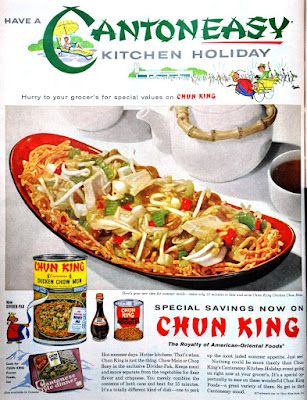
Chun King

Happy Chinese New Year!

I found an interesting bit of history on Chun King and its founder here. Jeno Paulucci was the son of Italian immigrants noticing a market for take-home food flavored from the Orient.
Mr. Paulucci became fascinated with the legumes and the fact that they could grow year-round despite Minnesota’s harsh winters. He began cultivating his own stock and selling the sprouts to restaurants as a salad ingredient.
Passing through towns hawking his bean sprouts, Mr. Paulucci saw many Chinese food restaurants but noticed that most grocery stores didn’t offer any prepared Asian dishes.
“The food industry was missing the boat, allowing restaurants to handle all the take-home business,” he once said.
He came up with his own chop suey recipe by canning his sprouts and adding bits of celery, pimentos and an Italian herb mixture suggested by his mother.
In 1947, he was loaned $2,500 from a friend and started Chun King. Beginning in 1960, he hired radio comedian Stan Freberg to host the “Chun King Chow Mein Hour” in honor of the Chinese New Year.
Despite what you might think of the authenticity of Chun King grocery store items, I'm saluting "The American Way" entrepreneurship  and the blending of cultures to create a successful market for a product.

Enjoy these mid-century Chun King ads:


November 4, 1957 Life Magazine


December 16, 1957 Life Magazine


January 27, 1958 Life Magazine


March 31, 1958 Life Magazine


June 23, 1958 Life Magazine


July 21, 1958 Life Magazine


August 18, 1958 Life Magazine


September 15, 1958 Life Magazine


October 20, 1958 Life Magazine


November 10, 1958 Life Magazine


December 8, 1958 Life Magazine


January 12, 1959 Life Magazine

Just in time for Lent!

March 16, 1959 Life Magazine


June 22, 1959 Life Magazine

Wednesday, February 6, 2013

Vintage Valentines

Happy Valentine's Day!


Mailed 1907


"Valentine Greetings - I send this card so you can see You've surely got a pull with me."


Mailed 1909


"Valentine Greetings. Life's rough places I will smooth, Pains and aches and troubles soothe."


"To My Valentine - In choosing mates let's you and I, Put all our trust in Cupid sly; Who reads our hears - And knows that mine, Was made for you - My Valentine."


Mailed 1914


"Valentine Remembrance - Open your door and let me in, Though but a merry rhyme, I come from one who hopes to win A deeper thought in time!"


"Valentine Wishes. My whole affection is set upon you. Please say you like me a little bit too."


mailed 1910. "To my Sweetheart. I love you, sweetest Valentine, To tell you let me dare, And we shall be, if you'll be mine, A very happy (pear)"


They sure don't write 'em like they used to! :)


Friday, February 1, 2013

Bill & Stella - Their Love Story

This post was inspired by the Valentine's card I came across recently that my Grandpa Hawes gave to my Grandma Hawes 50 years ago this month.  It prompted me to ponder their "love story":


The inside is here.

Stella Otelia Fredericks graduated Union High School in Bremerton in 1925 and went to work in Detroit where her older sister lived.


Sometime after Stella's return to Bremerton a year or so later, her parents took in a boarder named Mary Hubbell.  They went to a movie one night and behind them sat William John George Hawes with a friend.  Mary already knew Bill and introduced them to each other. Bill remembered Stella from school but Stella didn't remember him since he was a grade or two younger.  He would stare at her in Study Hall - he told people before they ever met that he was going to marry her. He ended up dropping out of high school – (more on that later).


A few weeks after the movie meeting, Bill asked Stella to the Crystal Ball - a dance for young Masons in DeMolay.  They dated for a year and were engaged for a year before they married.  When asked if there was a story of how he asked her to marry him, Stella replied, "No, no story - every time we went out he kept saying, 'so, when are we getting married?'"


Easter 1928

Bill was working at the Puget Sound Navy Yard as a Machinist at the time.  Apparently I’m in possession of stolen property; I hope the statute of limitations is up.  Grandpa used a little bit of metal and the machinist equipment to fashion these rings for the both of them - he even engraved her initials S. O. F. on hers.  Pretty romantic but illegal!


They eloped on January 26th, 1929. Stella worked Saturday morning (in the offices of Attorney Moore in Bremerton); they caught the ferry to Seattle and got married at Plymouth Congregational Church in Seattle. The newlyweds moved into their apartment Sunday and went back to work on Monday.

Grandma gave me a chocolate tin that she had kept.  I thought is was beautiful but I'm sorry I didn't ask questions about it.  I've been trying to find out more about Artstyle Chocolate Company but have not been very successful.  I have found their ads (in the historic archived Seattle Times) from the late 1920s which would coincide with their dating time frame so I kind of like to imagine this one pound tin box of chocolate was a gift he gave her when he was courting her.


She kept some random items in it and I've put a few more of her things in it - (White Shoulders is the fragrance I think of as hers . . . )


1929

Backing up - Bill had dropped out of high school at some point – I think to be able to work more hours.  He started working at age 14 (1921) as a delivery boy and later clerk at Diamond Drug Store which was later named Jamison’s Drug Co. and later still Olbergs on 4th and Pacific in Bremerton.  He also simultaneously started picking up work as a messenger boy for the PSNY.  Sometime in 1930, Bill went to work as a salesman for the Western Gas Co., in Bremerton.  He then purchased the merchandising department about June 1932 and was the Manager/Owner.  He sold it May 1933 to accept employment again at the PSNY. After marrying and one son, Bill earned his high school diploma from Bremerton High School (same school as his wife but the name had changed) in 1935. Another son (my Dad) was born in 1936. 


Work and life happened.  They had a home in Bremerton but also purchased a vacation home on Hood Canal. My Dad remembers his Dad was always off somewhere saying, "I'm off to see a man about a horse".  Bill initiated the bingo games for the Bremerton Elks as one of their primary fund raisers.  He was a manager of their travelling band and raised funds to get them new uniforms.  One of his highest honors was being elected Exalted Ruler of the Bremerton Elks for a year long term in 1951.  He was also an active Mason (just like his father) he had been installed as worshipful master in 1938. He enjoyed annual hunting trips.  My Grandma also returned to work after my Dad started Junior High.  Life was busy - they were both children of immigrants and living an American Dream.


I thought I remembered Grandpa still working for the PSNY when I used to stay with them in the summer – I remember you could hear the Shipyard’s whistle which signaled 5 o’clock quitting time and meant Grandpa was coming home.  But his obituary says he retired there in 1965 (age 58).  I would have been three so I don’t think I actually remember him coming home from the Shipyard.  After the Shipyard, he worked for Larkin Realty until retiring in 1972 at age 65.

It  was about that time that Grandma noticed Grandpa’s memory deteriorating.  I’m not sure when we actually had the official diagnosis of Alzheimer’s but it must have been heartbreaking for a wife of fifty years to be asked time and time again, “How often do you come to clean my house?” and other repetitive questions. For their 50th anniversary, my parents and aunt and uncle threw a party for them.  Grandpa had no idea why everyone was there.  He smiled big and kissed his wife when prompted.  But really didn’t know what was going on.


(My Dad's camera strap is visible standing above them - I've got my hand up to him)

Grandpa used to walk down the hill from his home to get his hair cut - he started getting lost returning home. They worried he would wander and put himself in danger.  It became obvious he needed to live in a secure facility.  I remember feeling like it wasn’t still a love-story if Grandma didn’t want to live and take care of Grandpa anymore.  They worked hard their entire lives but their Golden Years were robbed by dementia. Grandpa died in the nursing home in 1986.  Not really a "happily ever after" ending.  Just a real one.

If you're lucky enough to be "in love", take the time to enjoy and cherish it while it lasts.

Saturday, January 26, 2013

Battle of Seattle January 26, 1856

We went to visit the Museum of History and Industry (MOHAI) on Monday (Martin Luther King Jr. Holiday).  I am looking forward to returning and spending time lingering with the history preserved there.

There was one painting I recognized of The Battle of Seattle on display. I had seen it before as a black and white - I had looked around for more images of various Seattle events after reading "Four Wagons West - the Story of Seattle" written by Roberta Frye Watt in 1931.  She is the daughter of Louisa Denny Frye who was a pioneer child in the Wagon train out of Illinois to Seattle. (Louisa's parents are  Arthur Armstrong Denny (1822 - 1899) and  Mary Ann Boren Denny (1822 - 1910) )

I snapped a quick photo of it but my family was moving pretty quickly in this part of the museum.  It was painted by Emily "Inez" Denny, Roberta's older cousin.


I wish I had noticed next to it was more information about the Battle of Seattle that is now obvious to me as I look to the left of the painting in my photo.


This week I reread The Battle of Seattle chapter again and learned today marks the 157th anniversary of this historic event.  History is often awkward.  I'm appreciative that Seattle grew to what it is today.  But it wasn't without a history that can make you cringe. I'm including extensive excerpts of Mrs. Watt's chapter on the subject.  All text is hers except for text in yellow to clarify information.


Four Wagon's West - The Story of Seattle Roberta Frye Watt 1931

“The Battle of Seattle” Chapter 14 pages 227-241
Excerpts (a LOT of excerpts – all copyrights gratefully acknowledged)


“The weather that winter of ’55 was ironically beautiful. The settlers remembered afterward the lingering Indian summer days; the soft, warm rains that kept things green. David Denny remembered how they worked on the blockhouse in their shirt sleeves. Just before Christmas Mrs. Blaine wrote, “our little peach and apple trees are not stripped of their leaves yet.
“How this good weather mocked the farmers who had been obliged to come into the village and leave their farms to the Indians. How powerless they felt to be gathered in Seattle, waiting --- waiting for the forest to give up its secret.
 . . . . .
“It was a dark Christmas for Seattle and for the whole Territory. Of the gloom of those weeks Professor Meany writes:
‘The year 1855, as it drew to a close, saw the Territory of Washington enshrouded in gloom. It was not known how many Indians had suffered. They always managed to conceal their dead and rescue their wounded. But it was known that a considerable number of white people had lost their lives, many others had lost their homes. The survivors collected into blockhouse for mutual protection. The Indians gave continuous evidence of their presence. . . . Good was growing scarce – ordinary business was out of the question – starvation, flight, or the tomahawk seemed the only alternatives.’
. . . . 
“The suspense and ominous quiet in the village increased as the days passed. Where was Leschi? What move was he planning to make? Would the deep snows in the passes keep the warlike Owhi from crossing with his fierce Yakimas? Some pioneers felt confident that with the Decatur (sloop stationed in the Puget Sound harbor for protection - pictured in the Sound in the above painting) and their own armed volunteers they were well protected; others were afraid they would be overwhelmed by the greater number of the enemy.
 . . . . .
“In that week preceding the battle rumors of an attack were brought by friendly Indians, one of whom was Curley. Curley’s loyalty to the whites has been questioned by many, and undoubtedly the truth of the matter was that he was friendly to both sides. He would get a little ammunition and tobacco from Mr. Yesler, whom he knew very well since he had worked in the mill, and trade it for information which he would in turn bring back to Mr. Yesler. Indian Jim, whose sincerity was never questioned, also brought news to the whites; likewise the ‘klootchmen’ and other Indians who had worked in Yesler’s Mill and were his ‘tillicums.’
 . . . . .
“A few days previous he (Captain Gansevoort of the Decatur) had sent an Indian scout over to Lake Washington to find out what was going on. The scout returned on the afternoon of the 25th . . . with the startling news that one thousand Klikitats had crossed the mountains, and that for two days the local Indians had been bringing them across the lake in canoes.
The defenses were hurriedly strengthened. The disbanded (as of just the day before) volunteers took up their guns and were put on watch. Four divisions of soldiers and marines were posted by Captain Gansevoort to guard the town. . . . .
“The only vessel in the harbor beside the Decatur was a lumber bark, Brontes, which proved a faithful friend by sheltering some of the women and children.

“ . . . it was first planned to attack and massacre the settlers at two o’clock in the morning. But in order to have time to warn the whites, Indian Jim cunningly proposed waiting until later when the marines would have returned to the Decatur for breakfast after the night watch, leaving the town unguarded. This plan pleased the council and was decided upon. Curley, who according to one account, was also present, wanted to spare Mr. Yesler, who had given many of the Indians work in the mill, but the others insisted that everyone must be killed.
 . . . .
“Early the next morning, January 26, 1856, the Indians crept in close to the village and lined up along what is now Third Avenue, prepared to make a sudden attack on the cabins . . . Close as they were, however, the forest was dense enough to hide them from sight.
"Just at daybreak Indian Jim managed somehow in his native fashion to elude the others and slip in the back door of Dr. Williamson’s store with the whispered word that the Indians were upon them. The attack had come. Word was sent to Yesler at once.
“The night watch had reached the Decatur. The men were just beginning to eat breakfast when a canoe shot out from land carrying Mr. Yesler. Immediately the roll was sounded and the marines rushed ashore, back to the stations they had occupied the night before. The opportune moment for the Indians to rush on the cabins had passed.
 . . . .
“It was now eight o’clock. Candles in some of the cabins were still burning. Many of the men had just come in from the night watch. Some were eating breakfast when suddenly came the shattering, deep-throated report of the howitzer; the savage, fiendish yell of the natives; and the quick fusillade of shots. The battle of Seattle had begun! No one mistook this for a false alarm.
“Such a running for the fort! Louisa Denny grabbed Baby Inez (one month past her second birthday and the artist of the painting above) with one hand and tumbled a pan of biscuits just from the oven into her apron with the other and ran. David (Denny – Inez’s father, Louisa’s husband), who was on guard at the blockhouse, ran to meet her and helped her in. Mrs. Blaine and her new baby (born the Sunday before) bundled into a rocking chair and taken to the shelter of the Decatur. Virginia Bell, running for shelter, darted like a little scared rabbit between the legs of a marine who was in her path as she entered the blockhouse, knocking him to the floor with a scramble that added to the panic.
 . . . . .
“The first shot from the howitzer was followed by firing from the ship’s battery and an exchange of gunfire between the Indians and the volunteers and the marines. For two hours there was a steady booming and hammering of firearms while the white-faced women and children, huddled in the fort, prayed for the safety of their loved ones.
“Milton Holgate, an adventurous lad of fifteen, wishing to be outside the fort with the soldiers, started out and was shot and instantly killed as he was passing through the door. This tragedy added to the horror of the day to those waiting in the fort.
 . . . .
“A young man named Robert Wilson was also killed when standing on the porch of the Felker House. These were the only casualties of the day among the whites; they never knew how many Indians were killed . . . . . .
“The Indians had never engaged in such warfare before but stood their ground remarkably well. The cries of the squaws were heard urging their men on toward the blockhouse The Decatur’s guns rained cannon balls, shell, and grapeshot upon the forest beyond Third Avenue. This cannonading was supplemented by volleys from rifles and musketry of sailors and civilians. For years afterward shells from the Decatur were found embedded in the ground (some are in a display at MOHAI and you can see a few in the photo above). . .

“About noon Sheriff Thomas Russell, who had been across the Sound, came paddling to the rescue bringing with him some men from Meig’s Mill. In the afternoon the firing continued intermittently until about three o’clock. Once there was a prolonged lull. It was learned afterward that the Indians had stopped to feast on beef prepared by their squaws from the cattle of the settlers.
 . . . .
“Toward evening, scouts were sent out who reported that the enemy were placing inflammable material under and around the deserted cabins preparatory to burning them. Shells from the Decatur scattered incendiaries, but not before they had robbed some of the cabins of food and clothing.
“Mary Denny’s wedding gown was taken and she often wondered which squaw it was that went trailing her treasured dress through the woods.
 . . . . .
“According to Grant, this conflagration, planned for the evening after the battle, was believed “to have been the signal for all Indians on the beach and across the Sound to join in the attack” . . .the attack on Seattle was to have been so bold and successful that Indians on the reservations who were either neutral or friendly to the white men would be won over to their side.
“By ten o’clock that night both sides had ceased firing and all was quiet. But it was an ominous quiet. It was not peace.
 . . . .
“When the morning of the 27th dawned, the Indians had disappeared, taking many of the cattle with them. Chief Leschi sent back a boastful message that he would be back in another month and destroy the town. But he never came.
 . . . .
“The attack on Seattle, which was to have been the Indians’ decisive and triumphant act, had failed. Although the war continued in other parts of the Territory all that year, it was this battle that decided the struggle in Washington Territory between the Indian and the white man.
“The Indian chiefs miscalculated in many ways. For one thing, the fierce tribes that were leading the uprising defeated their own plans of uniting the Indians, for they had terrified the weaker tribes for so that it was now hard to gain their cooperation. . . .
 . . . .
“But for the presence of the Decatur Seattle might have been wiped off the map. But the ship alone could not have saved the village. The friendship of the settlers with the Sound Indians, and the fact that there was not one of these pioneers but did active service in the protection of the settlement helped immeasurably. At every step in its history, whatever the need, those enthusiastic young men swung an axe or shouldered a gun to make their vision real.

More from History Link
More from Paul Dorpat
More from Wikipedia

Sunday, January 13, 2013

Southcenter Tukwila 1987-1988

These are the last of the aerials that I have from a quarter of a century ago. (The other aerials are here: Seattle,  Bellevue, and Factoria)

Tukwila, Washington . . . Southcenter Shopping Center.


Facing West. Interstate 5 is at the top of the photo. The anchor stores are Frederick & Nelson, Nordstrom, The Bon Marche and J. C. Penney.  The Doubletree Inn is on the far left and a theater is in the upper right corner of the lot. 1987


Facing South. 1987


Facing North. Lucky (grocery), Pay-n-Save (drugs) 1987


This is south of the mall on Southcenter Parkway - At the time I worked at a photo lab called "60 Minute Photo Express" it was in the middle of this strip mall. If my memory hasn't completely failed me, I believe the balloon on the end of our building was for the grand opening of a Chuck E. Cheese. 1987


My Dad also worked in Tukwila at this Boeing building (S. 204th and 72nd AVE S. - 1988.)


Sea-Tac is visible in the upper portion of the photo. 1988


My Mom, Dad, the Pilot and me at Boeing Air Field after the 1987 excursion.


Wednesday, January 9, 2013

Eleventh Birthday Party

Last year I posted about my Fifth Birthday Party.  I came across these negatives last month (when I acquired my Dad's negatives including the aerials I've been posting).  My eleventh birthday - 40 years ago!  It was rather an awkward stage - but these photos make me smile.


I bet we got a good bargain after Christmas on the cute Gingerbread tablecloth and napkins.


The three girls on the right of this photo are named Kristin, Kristin and Kristine!


I got braces the summer before this.  I recall being the only student in fifth grade wearing them.  My orthodontist said I had a mature mouth.  Dutifully, I did exactly what he asked me to do including wearing my headgear religiously after school until the next morning except for mealtimes.  I think I kept overcorrecting - apparently his teenage patients weren't as diligent about following instructions as a 10/11 year-old so my teeth moved comparatively quicker.

My haul includes a Woodburning set, Hollie Hobbie collector plate "A True Friend is the Best Possession" (in photo "11" above, you can see two decoupaged Hollie Hobbie wall plaques - we were fans . . . ), Craft Master Acrylic Paint-By-Numbers, giant Hershey chocolate bar and red stuffed toy mouse.


There were 13 numbers on the dial on the top of that black-and-white TV behind me . . . we got channels 4, 5, 7, 9, 11 & 13 with those rabbit ears and it seemed like plenty of choices.


My sister (and her perfectly straight teeth without the need for braces . . . ) all ready for a slumber party!


We lived in this house in Eastgate (Bellevue) between 1964 - 1973 - we moved to Woodridge about a month after these photos were taken.

I must have gotten a diary for Christmas a few weeks earlier - these are the entries for the first half of January 1973 - with my creative spelling and all!


January 1: Last night we stayed overnight at the Sebrings house since Janis had to babysit us and their kids. Today we went to grandma’s house and in their basement we found a 1940 and a 1945 paper with the headlines, “Rosefelt Dead”. After dinner I had a surprise party since my birthday is in just eight more days. From my Grandma Hawes I got 10 dollars and from my Grandma Johnson I got four dresses! They gave me my presents today because they thought they wouldn’t be here on my birthday. On the way home we played “Three Coin” and I won most of the games.

January 2: Today was the first day of school from Christmas vacation.

January 4: Kevin O’Brien gave away 1687$ on KJR!

January 5: It snowed last night and we were one hour late going to school. We got our carpet today. Went to Crowders house for dinner and went sleding down there long hill and got back from their house 12:45 AM. *Everet died today
nicest bus driver

January 6: Dad put in are carpet today. The stretcher for the carpet put two holes in the walls.

January 7: Went to Fredrick & Nelsons to get Moms paycheck and then went out for lunch at Jack in the Box. Then went to House of Values and got are own record. I got “The Partridge family at home with their greatest hits” and Kristi got “America.”

January 8: Had an Orthodonist appointment and a doctor appointment today. Then we went to a fabric store and mom got some material to make pants for me. I got to school right in time for lunch.

January 9: Got a new kid in are class at school. They sanded are hill so now we can’t go sledding. My presents today were a Girl Scout knife, pillow and flashlight I also got a minature Raggedy Ann and little reed chairs. I also got pants, vest, origami paper, bath oil, stationary and 2 dollar. I babsat Bunky tonight. Qualey

January 10: Today is Mr. Gaily’s and Becky D Birthday

January 12: After school there was a movie called “The Cat” and we saw it. I had a Birthday Slumber party. I invited Kristin Groundland, Connie Haslam, Kristine Johnson and Shari Yates. From Kristin I got a paint by number set and from Connie I got a stuffed animal and a big Hershey Chocolate bar and from Kristine I got a plate that said, “A true friend is the best possession” and from Shari I got a wood burning set.

January 13: I started my cosins letter today. I bought a bike lock for my bike today and the combination is on the frount of this book.

January 15: Kevin O Brien gave away 1163$ and 95$

January 16: On TV we watched “The Night Strangler” and it was filmed in Seattle.
This was the only year I was decent about keeping a diary which is pretty entertaining for me to go back and read . . . .  life in 1973 Bellevue for an eleven year old girl.  I really do wish my children's ancestors had kept journals or diaries - it would be a thrill for me to catch a glimpse of their ordinary everyday lives.